

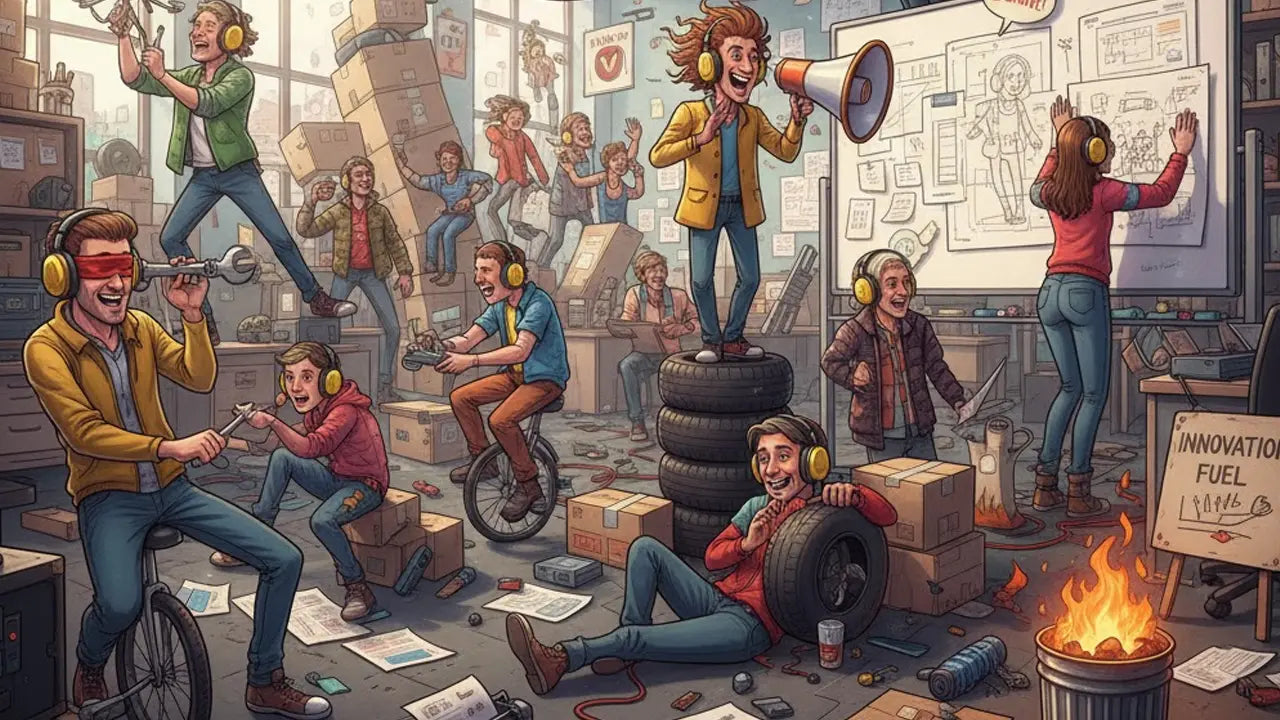
Valco’s organizational structure is deliberately built on an unconventional organizational model that we call the Minion Model™. This is not a joke, but a systematically constructed and theoretically radical approach to organizational behavior.
Experts are the problem. And consultants.
Our starting point is simple: most companies’ problems begin with having too many experts.
Experts are dangerous, because they carry around “best practices”. They think things should be done “properly”, while we think they should be done first, and only then should anyone stop to think about what the hell just happened.
The most dangerous of all are consultants. Especially the kind who wear a tie to work.
They go around spreading bad operating models they learned in corporations and universities, then try to apply them the exact same way to every company.
A consultant’s deepest goal is standardization: to make all organizations, processes, and people interchangeable. Because they can’t actually do anything else.
The end result: a world full of companies that look, sound and feel exactly the same. Which is why they’re all equally miserable. Except Valco.
Minion: the unit of learning
The Minion Model is the pinnacle of genius and is based on deliberately engineered inexperience.
Its basic unit is not the expert, but the minion - a person whose primary competence is the ability to absorb anything without yet understanding any of it.
A minion is a blank slate. They have no methods, no preconceptions, not even a clear idea of what they’re doing. That’s exactly why they’re dangerously effective. They act, fail, and learn - usually in that order.
Without set operating models and the shackles of expertise, minions adapt to the situation like water to a container: if needed, even into a religious cult or a paramilitary unit for corporate wars at the end of the world.
The philosophy of minioning and its theoretical foundation
The Minion Model is based on a simple management logic: if everyone only does what they already know how to do, nothing new will ever happen.
The theoretical core of the Minion Model rests on the concept of professional plasticity - an individual’s psychological ability to stretch into a task they have absolutely no qualifications for.
In other words: the less you know, the more you learn, and the more uncertainty there is, the greater the chance you’ll accidentally come up with by accident something nobody intended.
That’s why we give people jobs they’ve never done before. A minion in customer service might suddenly become sales manager minion, and Hannes from service might end up handling product development in China in Chinese. This is not chaos. This is learning - badly managed and random, but learning all the same.
If someone succeeds, it gets written down as a process.
If someone fails, it gets written down as a story.
Both are valuable, but only one ends up in the newsletter.
Specialized expertise is allowed. But useless.
Of course, in an international expert organization like Valco, there have to be people with specialized skills. One person can code, another is a sound wizard, and the undersigned is an incredible lover.
That still changes nothing. Minionhood is not a profession, but an existential state.
Previous competence is mostly just background noise hiding the essential thing: the ability to react to what happens when nobody knows what is happening.
This makes sure nobody has time to get too comfortable and the work retains a healthy dose of constant panic-flavored despair.
That despair is innovation’s most important fuel: the moment just before collapse is often when something that unexpectedly works gets born. Or doesn’t work, in which case we learn something new.
Management in the Minion Model
A leader’s most important job is to tolerate the fact that everything is, more or less constantly, completely fucked.
A bit like the dog in KC Green’s comic that became a meme, sitting in the middle of a fire. Except our dog is calm, because it understands this is normal business.
At the heart of the Minion Model’s management philosophy is the idea that at Valco we don’t really want to manage or direct anyone.
Minions are managed in situations where people are marched off to be shot or forced to dig salt out of rock. We usually do neither, so this company isn’t really managed in the literal sense of the word.
Direction is needed when the people around you don’t understand what they’re doing or they need to do something unintuitively stupid. A bit like in government administration. We, however, do not hire stupid people.
At Valco, the assumption is that people can aim toward a shared goal on their own, even if nobody is entirely sure what exactly that goal is.
The leader’s role is not to give orders but to exist. As a physical and mental entity that answers questions and serves as a source of bottomless knowledge, wisdom, and absolute clarity. It’s easy to keep a company running successfully when you just radiate the light of reason all around you.
Anyone who can’t manage that should go work for the municipality.
If the leader happens not to be reachable, and is, for example, off on a drinking trip in South America the model still doesn’t stop. The minions then rely on peer learning and the silent spread of knowledge, meaning that somebody vaguely remembers hearing something at some point that might be related.
That way, knowledge circulates organically and decisions emerge in a collective fog that has turned out to be weirdly effective.
Closing words
The Minion Model is not for everyone, but it works for us because it forces people to think and do at the same time. It stops us from becoming too sure of anything and guarantees that not even by accident can bureaucracy or rigid operating models come into being.
Honestly, it also works because we don’t know how or can’t be bothered to do anything else. Valco was founded from the start primarily as a joke - and accidentally, on the side, as a company. Chaos is strategy, mistakes are learning, and laughter is the only management system we’ve got.
And if someone ever asks: “If you’re so brilliant, why aren’t you a bigger company?”
The answer is simple: buy more headphones.
Share with friends
Now hiring: Marketing minions
VMK15 headphones for smaller heads, big sound